
Flange Size Guide for Breastfeeding Mothers

Breastfeeding is often a beautiful and fulfilling experience for mothers and their babies.
However, for new mothers adjusting to their new role, this can sometimes be a challenge.
One of the most important pieces of the pumping puzzle, and one that often gets overlooked, is finding the correct breast pump flange size.
The flange, also called the breast shield, is an important part of any breast pump. Most
commonly made from plastic or silicone, the flange comes in various sizes where the funnel shape goes around the nipple and areola and surrounds the breast during pumping. The right-sized flange can be the difference between a painful, inefficient pumping session and a comfortable, high-yielding one.

Why Does Flange Size Matter?
Using an ill-fitting flange is one of the most common reasons for discomfort, pain, and even nipple damage. Similarly, a flange that is too large can be ineffective and cause milk to leak. Getting it right is about comfort, efficiency, and protecting your milk supply.
A right-sized flange:
Maximises Milk Output: A well-fitted flange ensures the pump effectively stimulates
your milk ducts and creates an optimal vacuum seal, leading to a more complete milk
expression. When your breast is well-drained, it signals your body to produce more milk.
Ensures Comfort: Pumping should not hurt. The correct size prevents painful rubbing,
pinching, or swelling of the nipple and areola. Studies consistently show that an
individualized fit significantly improves comfort.
Prevents Nipple Damage: Too-small or too-large flanges can cause friction, bruising,
and nipple trauma, which can lead to complications like clogged ducts, mastitis, or
cracked nipples.
How to Find Your Perfect Fit: Step-by-Step
It is important to recognize that nipple sizes vary among individuals, and even between the
left and right sides. The following guide provides straightforward instructions for measuring and selecting the most suitable flange size.
Step 1: Measure Your Nipple Diameter
You'll need a ruler (in millimetres) or a printable nipple ruler.

Stimulate: Gently roll your nipple between your fingers to encourage it to stand up.
Measure the Base: Place the ruler or measuring tool across the base of your nipple (the widest part), where it meets the areola.
Note the Diamete: Measure only the nipple itself, excluding the areola. Take the measurement in millimetres (mm).
Step 2: Calculate your Recommended Flange Size
The optimal flange size is generally determined by adding 1–3 mm to the nipple measurement. This additional space ensures the nipple can move comfortably within the tunnel during pumping without rubbing against the sides.
Nipple Measurement (mm) | Recommended Flange Size (mm) |
14 - 16 | 17 - 19 |
17 - 19 | 21 |
20 - 22 | 24 |
23 - 25 | 27 |
26 - 28 | 30 |
Note: Most pumps in Malaysia come with a standard 24mm flange. If your size is smaller, look for flange inserts which are a cost-effective way to size down.
Signs Of A Correct Flange Fit
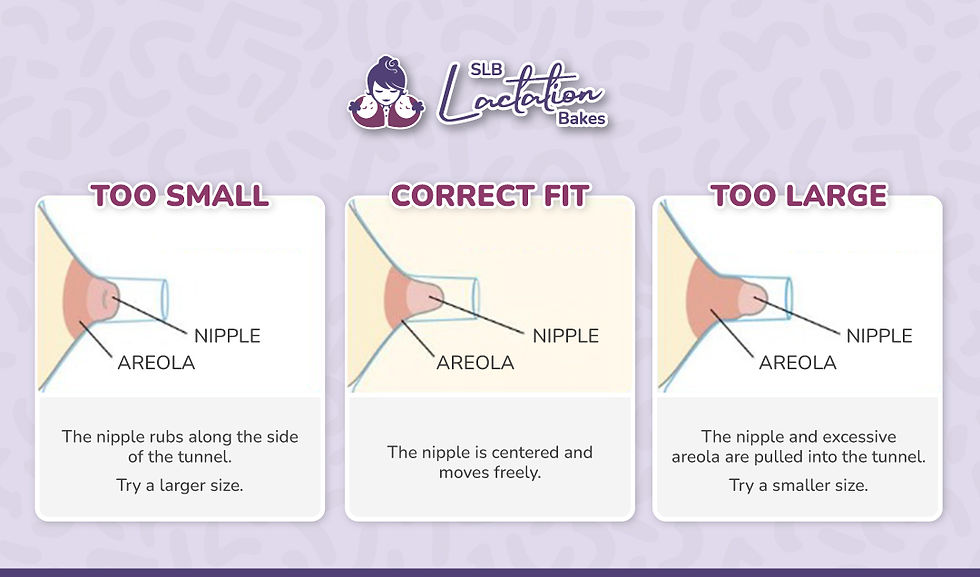
Once you start pumping, pay attention to the feedback from your body. As a reference, a good fit should adhere to the COMFY rule:
(C) Centred: Your nipple is perfectly centred in the flange tunnel.
(O) Only Nipple: Only your nipple (and minimal areola) is gently drawn into the
tunnel.
(M) Motion: Your nipple moves freely in and out without rubbing the sides.
(F) Feels Comfortable: Pumping is comfortable, with no pinching, pain, or significant
tugging.
(Y) Yields Well-Drained Breasts: Your breasts feel softer and lighter after the
session, indicating efficient milk removal.
Signs You Need To Change Your Flange Size
If you experience any of the following, stop and re-measure:
Nipple Rubbing: Your nipple rubs painfully against the sides of the tunnel. (Flange is too small).
Areola Pull-In: A large portion of your areola is sucked into the tunnel, along with the nipple. (Flange is likely too large).
Pain and Discomfort: You feel pinching, bruising, or pain during or after pumping.
Blanching: Your nipple looks white, red, or compressed after pumping.
Low Output: Your breasts still feel full after a 15-20 minute pumping session.
Keep in mind that your flange size may vary during your breastfeeding journey because of hormones, changes in milk supply, or even the time of day. It is perfectly normal to measure your size again every few weeks.
A successful pumping experience is all about having the right tools and knowing how to use them. Just like finding the perfect flange to ensure comfort and optimal milk flow, supporting your body with the right nutrition and energy is key to a flourishing milk supply. And this is where a little treat can make a big difference. SLB Malaysia’s delicious, nutrient-packed lactation cookies not only provide essential energy for mommies but are also traditionally used to offer gentle support for your milk production hormones, ensuring you stay nourished and your body has the strength it needs to produce that precious liquid gold for your little one.
Disclaimer: This article is for informational purposes only. Always consult a lactation professional for personalised advice on flange sizing and any breastfeeding concerns.
Image Credits:
Photo by Solen Feyissa, Unsplash https://unsplash.com/photos/woman-in-white-red-and-green-floral-shirt-4crXipFM1hc


Comments